The General Secretary of the Industrial and Commercial Workers’ Union (ICU-Ghana), Brother Morgan Ayawine, has called on Ghanaian weavers, leather workers and basket producers to embrace innovation, modern technology and improved production standards to expand their businesses and compete in local and international markets.
According to Mr Ayawine, the growing popularity of smock fabrics presents a significant opportunity for artisans to increase production, diversify their products and tap into international markets.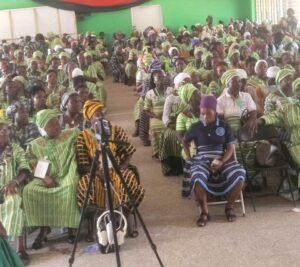
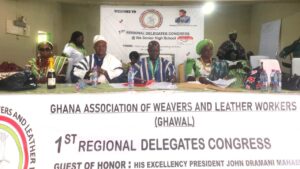
He made the call in a keynote address delivered on his behalf by Mr. Samuel Ananga, Deputy General Secretary in charge of Administration, of the Industrial and Commercial Workers’ Union, ICU-Ghana, at the first national conference of the Ghana Association of Weavers and Leather Workers (GHAWAL) held at the Wa Senior High School in the Upper West Region.
The conference was held under the theme, “Weaving for Future: Empowering Artisans for National Growth.”
Mr Ayawine said the smock weaving industry, which had traditionally been associated largely with the cultural traditions of northern Ghana, had in recent years gained wider national and international recognition.
“Until recently, the art of smock weaving had remained largely in the background when compared to other segments of the woven cloth industry,” he said.
He noted that the increased visibility and patronage of smock materials had created new opportunities for producers, adding that the material was increasingly being used to produce a wide range of fashionable clothing.
Mr Ayawine cited a recent fashion display by contestants of Ghana’s Most Beautiful on TV3 as an example of the changing perception and use of smock fabrics.
“I was particularly amazed recently when, during a fashion display by contestants of Ghana’s Most Beautiful (GMB) on TV3, I witnessed the wide variety of brands, colours and styles into which smock material had been transformed,” he said.
He said the material was being used to produce gowns, frocks, skirts, tops and other contemporary clothing, describing the development as evidence of its growing acceptance in Ghana.
According to him, the increasing popularity of smock fabrics should encourage producers to position themselves for mass production and develop products for both the domestic and international markets.
“You must therefore seize the moment and position yourselves for mass production of smock materials and their various clothing derivatives for both the local and international markets,” he urged.
The ICU General Secretary also called on GHAWAL to use its emergence as a national association to attract investment and government support for the formalisation, modernisation and expansion of the weaving and related clothing industries.
He said the association’s focus should include increasing production, improving quality, expanding markets and ensuring that artisans and their communities derive greater economic benefits from their work.
Mr Ayawine further encouraged the association to explore export opportunities under the African Growth and Opportunity Act (AGOA), while working with the Ghana Export Promotion Authority and other relevant institutions to ensure that products meet international standards.
“Working closely with the Ghana Export Promotion Authority (GEPA) and other relevant institutions, your products can be developed and positioned to meet international standards and gain access to lucrative export markets,” he said.
He said leather workers and basket producers also had significant opportunities to expand their businesses, citing the quality and creativity demonstrated in the production of shoes, bags and other leather products, as well as locally made baskets.
“What is required is a deliberate and coordinated effort to improve product quality, packaging, branding, marketing and access to finance, while also equipping artisans with the appropriate technical and entrepreneurial skills,” he stated.
Views: 4


 BTA Admin